

Apple's Repair Pricing vs Component-Level Repair: Why the Bill Can Look So Different
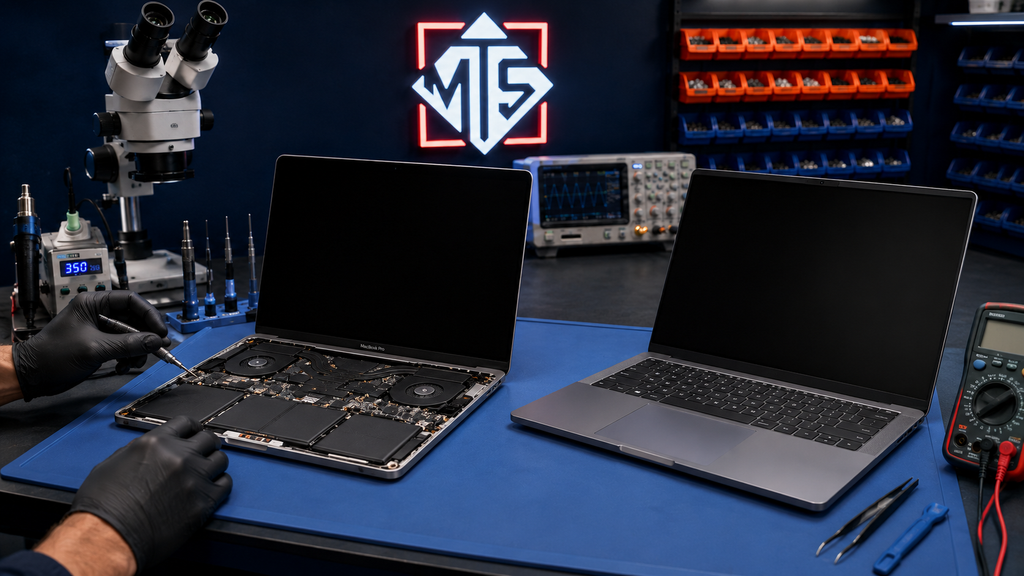
If you've ever gotten a repair quote for a cracked MacBook screen or a tired battery and thought "surely it's not that expensive to fix," you're not wrong to wonder. In many cases, the actual faulty part costs a fraction of the quote — the rest comes down to how the repair is priced, not how expensive the fault really is.
Why a "Simple" Fault Can Come With a Big Quote
Apple's own repair pricing — and the pricing of many manufacturer-authorised services — is generally based on replacing the whole assembly the fault sits in, not just the failed part. A cracked corner of glass can mean pricing for an entire new display assembly. A battery that's dropped below 80% health can mean pricing that assumes the whole top case needs to come off. That's a deliberate, supportable approach for a manufacturer managing repairs at global scale — but it isn't the only way to fix the problem.
How Whole-Assembly Pricing Works
Manufacturer and manufacturer-authorised pricing is typically tiered by fault category (screen, battery, general repair) rather than by the specific component that failed. It's simple to quote and consistent across locations, but it means a customer with a genuinely minor, isolated fault can end up paying for parts and labour well beyond what that specific fault required — because the pricing tier doesn't distinguish "one cracked corner" from "the whole screen is destroyed."
What Component-Level Repair Changes
Component-level repair — the approach we use for logic-board and circuit-level faults, and wherever else it's genuinely viable — starts from a different question: which specific part failed? Instead of assuming the whole assembly needs to go, a technician diagnoses the actual failed component and repairs or replaces just that. We've written previously about how this plays out for microsoldering and component-level logic-board repair — the same underlying principle applies to a range of hardware faults, not just charging or logic-board issues.
| Whole-assembly / flat-rate approach | Component-level approach |
|---|---|
| Priced by fault category (e.g. "screen repair," "battery service") | Priced by the specific component diagnosed as faulty |
| Simple, consistent, but can significantly overcharge for a minor, isolated fault | Requires proper bench diagnostics first — more upfront technician time, but a tighter-fitting price |
| Usually the only option through a manufacturer's standard service | Depends on the specific fault and board being genuinely repairable at component level |
A Real-World Example: Battery and Screen Faults
Independent Australian repairers publish a wide range of MacBook battery and screen repair pricing — reported ranges we found while researching this article span roughly $150–$520 for battery replacement and $250–$850+ for screen replacement, depending on the model, the specific repairer, and whether the fault is treated as a simple part swap or a more involved assembly replacement (see sources below). The size of that range itself makes the point: the "same" fault can be priced very differently depending on what's actually being replaced and how the job is scoped.
When Whole-Assembly Replacement Is Still the Right Answer
Component-level repair isn't always cheaper or even always possible. If damage has spread across multiple areas of a board or assembly, if a component package is too difficult to rework safely, or if the cost difference between component-level repair and assembly replacement turns out to be marginal once labour is factored in, replacing the whole assembly can still be the more sensible — sometimes the only realistic — option. We cover how to weigh that decision more broadly in our repair-or-replace decision guide.
What This Means for Your Wallet — And How Macrotech Quotes
We diagnose the actual fault on the bench before quoting anything. If a fault is genuinely fixable at component level, that's usually the more affordable path and we'll say so; if the board or assembly genuinely needs full replacement, we'll explain why. Either way, you get a written, itemised quote — based on what's actually wrong with your device — before any work goes ahead, not a generic price for the fault category.
Local to Carrum Downs, Frankston or the Bay-Side Suburbs?
We're based at 50 Titan Drive, Carrum Downs, and quote every job individually for customers across Frankston, Seaford, Langwarrin and Skye, and Patterson Lakes. See our Apple Mac repair services for more on our component-level and logic-board repair capability.
Frequently Asked Questions
Is component-level repair always cheaper than a manufacturer quote?
Usually, but not always — it depends on the specific fault. A genuinely isolated component failure is typically much cheaper to repair at component level; widespread damage may end up costing about the same either way.
Will independent repair void my Apple warranty?
It can affect coverage for the specific area repaired, depending on your device's warranty status. Check with Apple directly, or ask us to help confirm your current coverage before booking.
How do I know which type of repair my MacBook needs?
That's exactly what the $50 diagnostic covers — we test the actual fault on the bench before recommending component-level repair or full assembly replacement, and give you a written quote either way.
Do you publish fixed prices for every repair?
No — because the right price depends on the specific fault, we quote after diagnosis rather than publishing a generic price list, so you're never paying for more repair than your device actually needs.
Got a quote that seems higher than it should be?
Book a $50 Diagnostic for a Second OpinionMacrotech Solutions is an independent repair service and is not affiliated with Apple Inc. Third-party pricing ranges cited in this article reflect independently published Australian market rates at the time of research and are provided as general context only.