

Why Are Laptops and MacBooks More Expensive in 2026?
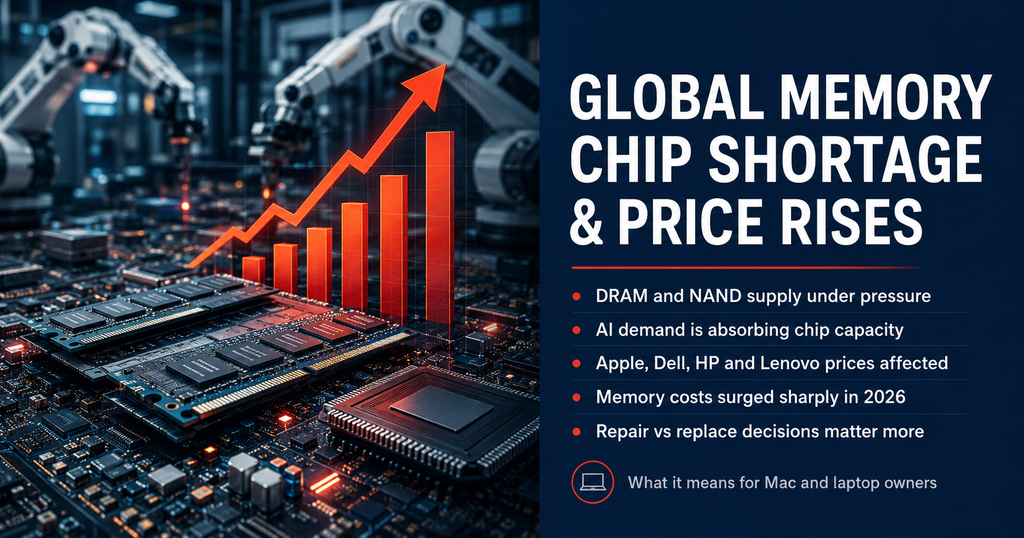
If you've priced up a new MacBook, iMac or Windows laptop recently and the number seemed higher than you remembered, you're not imagining it. Apple, Dell, Lenovo and HP have all raised prices in 2026, and the cause isn't demand for any one device — it's a global shortage of the memory chips that go inside almost every computer built today.
This guide explains what's actually driving the price rises, what's confirmed versus still developing, and — because Macrotech is a repair business, not a retailer — what it genuinely means for the repair-vs-replace decision if your current laptop or Mac is starting to show its age.
The Short Answer: A Global Memory Chip Shortage
Every laptop, MacBook and desktop computer relies on two types of memory chips: DRAM (the working memory that runs your system while it's on) and NAND flash (the chips inside SSDs that store your files). Since late 2025, demand for these same types of chips from AI data-centre operators has surged, and chip makers including Micron, Samsung and SK Hynix have shifted production capacity toward higher-margin AI hardware. That's left less capacity for the memory chips that go into consumer laptops and desktops, and prices for the remaining supply have risen sharply as a result.
Market analyst TrendForce, which tracks memory pricing industry-wide, reported DRAM contract prices rising as much as 98% in the first quarter of 2026 alone, with a further 58–63% quarter-on-quarter increase forecast for the second quarter. By the third quarter of 2026, TrendForce's tracking showed price growth moderating but still rising, with DRAM up a further 13–18% and NAND flash up 10–15% quarter-on-quarter. Analysts describe this as a structural shortage rather than a short-term blip, since new manufacturing capacity typically takes years to bring online.
Apple Raised Australian Prices by Up to 25% in June 2026
Apple increased Australian pricing across most of its Mac and iPad range on Friday 26 June 2026, attributing the change directly to rising memory and component costs. According to reporting from Information Age (ACS) and SmartCompany, and corroborated by TechRadar and 9to5Mac, the increases included:
| Device | Previous AU price | New AU price | Approx. increase |
|---|---|---|---|
| MacBook Neo | $899 | $1,049 | ~17% |
| MacBook Air (M5) | $1,799 | $2,099 | ~17% |
| MacBook Pro (M5) | $2,699 | $3,199 | ~18.5% |
| iMac | $1,999 | $2,399 | ~20% |
| Mac Studio | $3,499 | $4,299 | ~23% |
| iPad Air | $999 | $1,249 | ~25% |
Apple's own statement, as reported by these outlets, cited "unprecedented demand for memory chips used in AI infrastructure" as the reason. Apple's share price reportedly fell around 6% on the day the price rises were announced, which several outlets linked to investor concern over margin pressure rather than the price rise itself.
Worth knowing: the MacBook Air with M5 launched in March 2026 with double the previous generation's starting storage (512GB) and a faster SSD, per Apple's own product announcement — meaning part of the price difference reflects a genuine spec upgrade, separate from the June price rise applied on top of it.
It's Not Just Apple: Dell, Lenovo, HP and Others Have Also Raised Prices
The memory shortage isn't an Apple-specific story. According to TrendForce's own reporting, Dell raised commercial PC prices by 15–20% from mid-December 2025, with Lenovo following from January 2026. Broader industry coverage in 2026 (Gulf News, Tom's Guide, TechRadar) describes price increases across Dell, HP, Lenovo, Acer and ASUS in the 15–30% range through the year, with memory and storage components now estimated to make up around a third of a laptop's manufacturing cost — up from roughly 16–20% historically, according to industry analysts cited in that coverage. Reporting also indicates PC makers have warned business customers that placing an order today does not guarantee current pricing will hold through to delivery.
The MacBook Air Is Now Facing Shipping Delays Too
As of early August 2026, reporting from 9to5Mac indicates the memory shortage has started affecting availability as well as price — base-model MacBook Air units are reportedly facing shipping delays pushing into late August and September, a shortage that had previously been more concentrated in lower-volume machines like the Mac mini and Mac Studio. This is developing reporting rather than an Apple-confirmed statement, so treat specific delivery dates as indicative rather than fixed if you're currently waiting on an order.
Why This Changes the Repair-vs-Replace Equation
None of this is a reason to panic-buy a new device, but it is a reasonable prompt to look at the numbers differently than you might have a year ago.
New devices cost more — but most repairs haven't
The cost of a screen, battery, keyboard or charging-port repair is largely unrelated to DRAM and NAND pricing, since these are mechanical and lower-cost electronic components rather than memory chips. That means the gap between "repair this" and "replace it" has widened in favour of repair for a lot of common faults, purely because the replacement side of that comparison has become more expensive.
Apple Silicon Macs can't have RAM upgraded — which matters more now
On every Apple Silicon Mac (M1 through M5), unified memory is fabricated as part of the same chip package as the processor. There's no RAM stick to swap or add — the memory capacity you buy is the memory capacity you keep for the life of the device. That was always true, but it matters more when the alternative (buying a new Mac with more memory) costs noticeably more than it did last year. If your Mac is struggling because of memory pressure rather than a hardware fault, it's worth getting an honest diagnosis of what's actually causing the slowdown before assuming a new machine is the only fix — see our guide on what's actually causing a slow or overheating Mac.
Windows laptops can often still be upgraded
Many Windows laptops, particularly older models, still use replaceable SO-DIMM RAM and swappable M.2 or SATA SSDs. Where that's the case, a storage or memory upgrade can meaningfully extend a laptop's useful life for a fraction of the cost of a new one — though with SSD and RAM component prices also elevated by the same shortage, it's worth getting a current quote rather than assuming last year's upgrade pricing still applies.
Signs Your Current Laptop or Mac Is Worth Repairing
- The fault is isolated to one component — battery, screen, keyboard, trackpad or a charging port — rather than the whole system failing
- It's running slow or overheating, and the cause hasn't actually been diagnosed yet (this is very often fixable — see our Mac and Windows diagnosis guides)
- It otherwise still meets your needs and the repair quote is well below the cost of a comparable replacement
- You have data on it you haven't backed up elsewhere and want to avoid a forced migration
Signs It's Genuinely Time to Replace
- Multiple major components have failed or are failing at once (logic board plus battery plus screen, for example)
- The device can no longer run the software or operating system updates you actually need for work or security
- A repair quote approaches the cost of a comparable new or refurbished device
- The device has been repaired for the same fault repeatedly without a lasting fix
How Macrotech Can Help SE Melbourne Customers Right Now
We repair MacBooks, iMacs, Mac minis and Windows laptops and desktops for customers across Carrum Downs, Frankston, Cranbourne, Lyndhurst, Langwarrin, Seaford, Skye, Patterson Lakes and the surrounding southeast Melbourne suburbs — covering everything from battery and screen replacement to logic-board and motherboard-level diagnostics, SSD and storage upgrades, and data recovery. With new-device prices up across the board in 2026, an honest diagnostic is a low-cost way to find out whether your current machine still has life left in it before you commit to a more expensive replacement.
Not sure whether to repair or replace?
Book a diagnostic and we'll give you an honest assessment of what's wrong and what it will cost to fix — so you can compare that against a replacement with real numbers, not guesswork.
Book a DiagnosticFrequently Asked Questions
Why are laptop and MacBook prices going up in 2026?
A global shortage of DRAM and NAND flash memory chips, driven largely by AI data-centre demand, has pushed component costs sharply higher through 2026. Manufacturers including Apple, Dell, Lenovo and HP have all passed some of that cost on to customers through price increases, according to market analyst TrendForce and multiple technology outlets.
Will laptop and MacBook prices come back down?
Not in the short term, based on current analyst forecasts. TrendForce and other memory-market researchers describe the shortage as structural rather than temporary, with meaningful new manufacturing capacity unlikely before late 2027. This is an industry forecast, not a guarantee, and conditions can change.
Can I upgrade the RAM or SSD in my MacBook instead of buying a new one?
It depends on the model. On Apple Silicon Macs (M1 through M5), unified memory is built into the same chip package as the processor and cannot be upgraded after purchase. Storage is soldered on many recent models too, though some older MacBooks and most Windows laptops can still have storage or memory upgraded by a specialist. A diagnostic will confirm what's possible for your specific device.
Is it worth repairing an older laptop or MacBook in 2026 given how much new devices now cost?
Often, yes, for common faults like a worn battery, cracked screen, faulty keyboard, charging fault or an ageing SSD. With new-device prices up significantly, a repair that used to be a marginal decision now compares more favourably against buying new. Every device is different, so a proper diagnosis is the only way to know for certain.
How do I know if my laptop's SSD is failing rather than something else?
Common warning signs include slow file access, frequent freezing, files that won't open or save correctly, and unexpected restarts. We've covered the full list of warning signs in a dedicated guide, since SSD failure is often mistaken for a general slowdown or software fault.
Independence disclaimer: Macrotech Solutions is an independent computer and Mac repair specialist. We are not affiliated with, authorised by, or sponsored by Apple Inc., Microsoft Corporation, Dell, Lenovo or HP. All product names and trademarks belong to their respective owners. Pricing figures cited in this article are drawn from public reporting by the sources listed and were accurate as reported at publication; contact the manufacturer directly for current retail pricing.
Related Macrotech guides: Is your SSD about to fail? · Mac running slow or overheating · Windows laptop running slow · MacBook Pro M5 repairability · Framework Laptop 2026 repairability